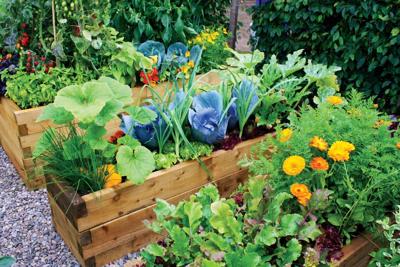



Human relationships are complementary. Whether romantic or platonic, parties are drawn to each other because mutual needs are met. The same idea applies in the garden. Some plants, like people, grow best with the right companion. Garden matchmakers thoughtfully pair crops based on compatibility, setting the stage for both to flourish. Psychologists call it complementary needs theory. Green thumbs would simply say “companion planting.”
A classic example is the Three Sisters method in which Mesoamericans planted a complementary trio of corn, beans, and squash. Corn grows tall and straight, creating a natural trellis for climbing bean vines. Since corn requires a lot of nitrogen, it pairs well with beans, which capture nitrogen from the air and enrich the soil. Beans also anchor the corn stalks, providing extra stability against blustery winds. At the ground level, squash sprawls out across the ground, shading the soil to keep weeds at bay; its prickly leaves can also help deter hungry pests.
People are also reading…
This method amplifies strengths and moderates weaknesses. The mix also ensures complete dietary nutrition, as all essential amino acids are provided. Remarkably, these benefits were all deduced from observation without any scientific trials — a testament to the resourcefulness of the Mesoamerican peoples.
To qualify as companion planting, two or more species must share the same footprint in time and space. It’s a type of intercropping or polyculture similar to mixed use zoning. The benefits can be one-way (beneficial to one party, neutral to the other), like providing nectar-rich flowers around fruiting crops to give pollinators an extra boost. Or, plants may be mutually beneficial as modeled by the Three Sisters.
Here are some additional benefits to companion planting:
1) Space is maximized, allowing more plants to fit in a smaller area while increasing overall productivity.
2) Soil health is improved as roots naturally loosen compacted ground, improving airflow and acting as living tillers. Select species can also support helpful microbes — such as bacteria in nitrogen-fixing nodules or mycorrhizal fungi — that boost plant growth and make it easier to access nutrients.
3) By creating hideouts for beneficial insects, gardeners can attract predators and parasitoids that set up camp nearby, on call 24/7 to manage pests.
4) Flowers can help keep pests away by masking the scent of nearby plants. Mixing plant shapes, heights, and colors can also confuse pests, making it harder for them to find a host.
5) Trap crops, planted near main crops, serve as a decoy to draw pests away from the more important signature crops.
6) Some crops release growth-promoting compounds, boosting the vigor and yield of their neighbors.
So, what constitutes a “companion”? Most companion plant pairings are either neutral or at least somewhat beneficial. General recommendations are to avoid planting crops from the same family together (unless one is being used as a trap crop) since they often attract the same pests and diseases. You should also avoid pairing plants with very different growth habits — like placing a smaller, sun-loving plant next to a larger one that leafs out like an umbrella.
There are a few examples of pairing faux pas that provoke a toxic relationship with the partner. Rye, usually planted as a cover crop, releases herbicide-like compounds into the soil as it decomposes. This property, called allelopathy, is a type of plant-to-plant chemical warfare. Black walnut is another culprit as very few plants will grow under its drip line.
Factoring in these few exceptions, there are countless possible pairings. Just remember that many are based on hearsay, superstition, and old wives’ tales. Even those supported by scientific studies may be contradicted in the same body of literature. With that said, experimenting on your own garden is unlikely to do any harm and can still reveal some useful partnerships.
In companion planting, the whole is greater than the sum of its parts. Think of it as a horticultural clique where each member contributes to the other’s success. With a little planning and a spirit of experimentation, your garden can thrive with the help of well-matched blossom buddies.