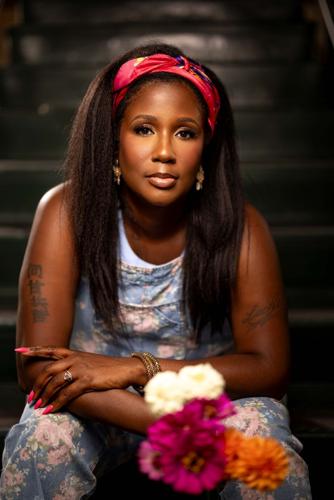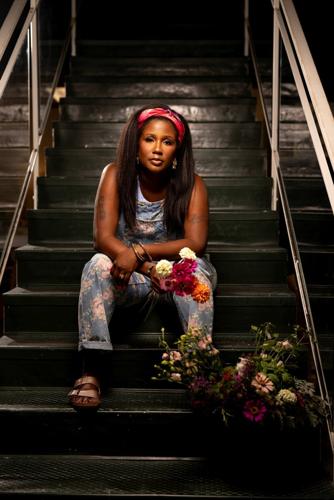



Dee Hall Goodwin is often asked what her favorite flower is, and the answer is the same each time: “Whatever flower I’m looking at,” she says with a laugh. She’s partial to dahlias and ranunculi because their varieties can differ so vastly, resembling a rose, peony, or poppy. “I like flowers that have lots of cultivars within the type.”
It’s not uncommon for Goodwin to “nerd out” on flowers (her words). Growing up across the street from a botanical garden in Brooklyn, she tended an urban plot and was surrounded by a family of gardeners. Wherever she’s lived, she’s kept a garden, including the pollinator haven she began after moving to Norfolk’s Colonial Place neighborhood seven years ago. What started as a way to attract goldfinches soon sparked a bigger idea: She didn’t need — or even want — grass. “It has no environmental benefit,” she notes. So when a neighbor suggested how neat it would be to turn the entire front yard into a pollinator garden, Goodwin replied, “Stay tuned.” Naturally, she did just that.
People are also reading…
Having familiarized herself with Coastal Virginia’s rich agricultural history, she was disappointed that she couldn’t find a local grower for her wedding florals. “It was really important for me to have things that were seasonal, that were of that moment specifically,” she says. “I wanted it to reflect those things because I am a gardener; I wanted it to look like these things belonged.” She started to wonder if she could become the local grower she was searching for. And, of course, she did it.

Goodwin founded the Tidewater Flower Collective and Black Flower Farmers to create supportive networks among a small section of an already tight-knit community.
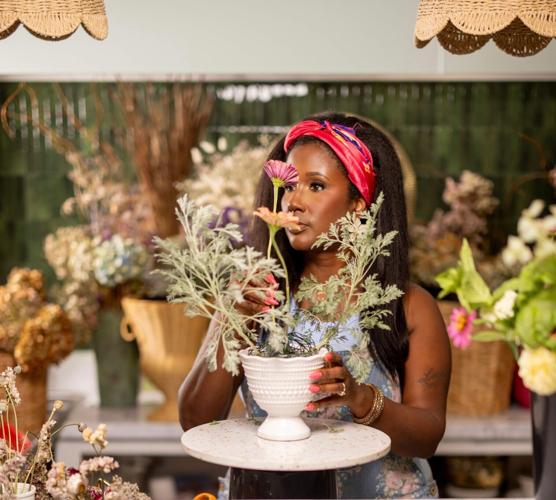
In fall 2020 she launched Mermaid City Flowers, a specialty cut-flower urban microfarm and design studio providing florals for weddings, showers, parties, funerals, condolences, and everyday moments. Her designs are naturalistic. “I don’t make the roundy-moundy, traditional bouquets,” she says. “If you want that, there’s a place for that, but that’s not my style. I like stuff that looks like I just went out and cut it — because I just did.” Her focus doesn’t lie in symmetry but rather in each flower’s color, texture, and scent — something that imported flowers often lack.
Business is blooming. In 2023 she moved her business into The Studio on Colley, a shared space with five women entrepreneurs working in painting, photography, jewelry, and interior design. This summer, she launched a flower truck — converted from gas to electric by a guy in Surry — that she parks outside the storefront, at markets, and at events where guests can build floral arrangements from a bouquet bar. Beyond marketing the business, she envisions the truck as a teaching tool.
“I lure them in with the flowers, and when they’re dazzled, I’m shoving a little bit of education and knowledge in there,” she says. Much of her teaching centers on sustainability. For example, she might grow basil from seed, cut a stem for an arrangement, then encourage the recipient to root it and grow a new plant for their garden or kitchen. “That’s a closed loop happening between five miles of where this seed was started,” she says.
That spirit of teaching has grown alongside her own journey. Goodwin describes the last few years as a constant learning process. “I tell people gardening is a big experiment, and the only way you can learn is on the job,” she says. “You can read as much as you want. The plants don’t read those same books.”
She laughs about the missteps too. “I’m a perpetual failure,” she says. “I just have a professional name for that; it’s called compost.”
Her willingness to learn and share spills into a wide range of teaching opportunities. She lectures on horticulture, native plants, community gardens, and floral topics for professional organizations, garden clubs, and universities. She has served on the Garden Club of America’s Common Ground Collaborative, which awards grants for community projects. At The Studio on Colley, she keeps it hands-on with workshops on design basics, herbal bouquets, and sprout-and-sip events.
Goodwin also serves on the President’s Council on Inclusion and Diversity at Norfolk Botanical Garden, which awards scholarships for young people pursuing green careers and highlights the organization’s history. “The Botanical Garden was the only WPA [Works Progress Administration] botanical garden in the country, and it was built by Black men and women,” she says. “They took a swamp and converted it into this area full of azaleas.”

Goodwin founded the Tidewater Flower Collective and Black Flower Farmers to create supportive networks among a small section of an already tight-knit community.
That rich history ties back to her own personal botanical history and was a fulfilling discovery for her to learn upon moving here, she says. Each year, the Garden hosts a celebration honoring those workers — only 76 of the 220 are known by name — alongside their descendants, who continue to share their stories.
Although Goodwin doesn’t have a formal teaching background, she enjoys witnessing people have lightbulb moments or take away knowledge they didn’t have before. “I see part of my responsibility, as a person with a platform, to help people learn about the positive effects of having plants around and about climate change” — something she sees firsthand.
“Being in Norfolk, especially in these low lying parts, we’re at ground zero for climate change,” she says. “You see it more intimately when you live blocks from the river and deal with nuisance flooding.” On walks along the Lafayette River, she hears from neighbors about trees that lined the water 30 years ago — trees that are no longer there, a change driven by the river’s brackishness and rising waters.
The effects show up in the garden, too. Flowers bloom earlier than expected, and what seems unusual at first eventually becomes clear: Over time, it’s evident these shifts reflect real environmental changes. Goodwin is adapting her crop planning by planting flowers in more shade to account for the longer, hotter periods. “I can’t change the environment, but I can change the conditions.”

Along with teaching community members what she knows about horticulture, she’s launched multiple groups for growers to connect and learn from one another as well. First she founded the Tidewater Flower Collective, “so I could bully people into being my friend,” she jokes. The group is composed of growers of different scales located in Norfolk, Virginia Beach, and Chesapeake, as well as the Eastern Shore and Peninsula. They interact in a variety of ways: participating in plant swaps, serving as resources for one another, freelancing for one another for events, sharing the cost of bulk seed orders, and buying florals from one another.
She also founded Black Flower Farmers, an international collective made up of nearly 60 members. Black farmers encounter unique barriers including limited access to land, historical discrimination in USDA grant applications, and family expectations that farming isn’t a pursuit for educated individuals. “There is the family perception of, we left that; we don’t have to do that anymore. I’ve given you all this education. Why would you want to return to the land?” Goodwin explains.
The Black Flower Farmers collective recently received its first grant to help lower barriers to entering horticulture: supporting continuing education, memberships to helpful organizations, and guidance on pest control options. “We have this concentrated group of people who are just getting started, and we have people with decades of experience and expertise,” Goodwin says. “That’s a really nice mix and a nice space to have.”
Goodwin acknowledges that flower farmers represent a small section of an already tight-knit community. “Lots of farmers continue to age and are aging out. Farming is not necessarily cool; it’s not something people do because they’re going to get super rich,” she says. “I want people to see what the possibilities are, that they can do it, that they can make it sustainable, that they can do it in a nontraditional way and make it work. It can be whatever you want it to be.”
She emphasizes that gardening doesn’t have to be on a large scale. “We don’t all have the capacity or ability to do it in this way, but you can do something small,” she explains. “Leave basil in water and see what happens. Put it in a little pot. It becomes a great way to empower people, to show them what they are capable of, something that they can take home, and take into their communities to show other people.”